How do you calculate wind correction angle and groundspeed?
Draw three vectors: the airplane through the air (heading and true airspeed), the wind, and the result over the ground (course and groundspeed). The wind correction angle is asin(crosswind ÷ true airspeed), and groundspeed is the airspeed along the course minus the headwind. The E6B's wind side solves this same triangle.
- True heading
- 359°
- Magnetic heading
- 8.75°
- Wind correction (+ right)
- -1.25°
- Groundspeed
- 150 kt
E6B: Training aid only, not for navigation or flight. Verify with your POH/AFM and approved sources.
More settings
Play
Swing the wind around the compass and watch the heading crab into it.
Stuck? Pick one of the examples from the “Try an example” menu, or press “New example.”
Understand
The wind triangle adds two vectors. The airplane moves through the air on its heading at its true airspeed, and the air moves over the ground with the wind. Their sum is the path over the ground: the course and groundspeed.
To hold a course, you turn the nose into the wind just enough that the sideways part of the wind is cancelled:
The blue arrow is the airplane through the air, the dashed arrow is the wind, and the orange arrow is where you actually go.
Use
Every input has a unit menu, so you can type values in the units you already have. Results follow your units.
Show the work
- Wind angle off the course
\text{WD} - \text{TC} = 185^\circ - 0^\circ - Crosswind and headwind parts
W\sin(\cdot) = -2.615\ \text{kt},\quad W\cos(\cdot) = -29.89\ \text{kt} - Wind correction angle
\text{WCA} = \sin^{-1}\frac{30\sin(185^\circ - 0^\circ)}{120} = -1.249^\circ - True heading, then magnetic
\text{TH} = \text{TC} + \text{WCA} = 358.8^\circ,\quad \text{MH} = \text{TH} + \text{var}_W = 8.751^\circ - Groundspeed
\text{GS} = \text{TAS}\cos(\text{WCA}) - W\cos(\text{WD} - \text{TC}) = 149.9\ \text{kt}
Export
Enter true airspeed, true course, and the forecast wind (true direction). Add magnetic variation in "More settings" to get a magnetic heading to fly.
- Add compass deviation from your aircraft's deviation card to get compass heading.
- Winds change with altitude and time. Check groundspeed against checkpoints in flight.
For learning and estimation. Verify with applicable codes, standards, and a qualified professional before using in design, construction, or safety-critical work.
Cheat card
| Symbol | Meaning | Unit |
|---|---|---|
| true course, where you want to go | ° | |
| wind direction (from) and speed | °, kt | |
| true airspeed | kt | |
| wind correction angle, + right | ° |
- Winds-aloft forecasts are true; ATIS and tower winds are magnetic. Don't mix them.
- Correct into the wind. Wind from the right means a right correction.
- "East is least, west is best": subtract east variation, add west, to get magnetic heading.
Where it’s used
- Aerospace
Pilots work the wind triangle on every cross-country leg to get a heading to fly and a groundspeed for timing and fuel. - Driving & Travel
The same triangle explains why a flight west against the jet stream takes longer than the flight back.
Related exhibits
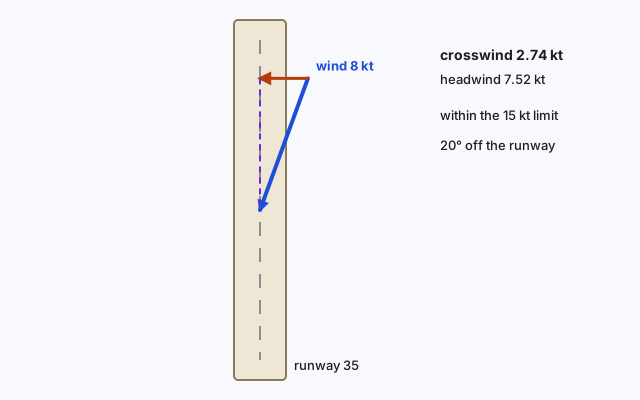 Start here
Crosswind landing: splitting the wind into two parts
Pilots break the wind into “along the runway” and “across it.” That’s vector math at 60 knots.
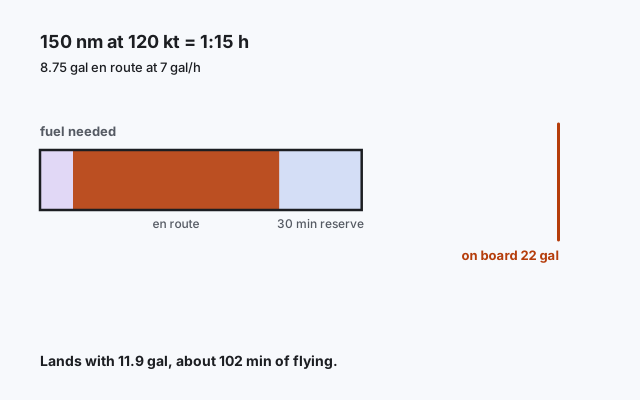 Go further
E6B time and fuel: will it make it with a reserve?
Distance over groundspeed gives time; time times burn gives fuel. Then leave something in the tanks.
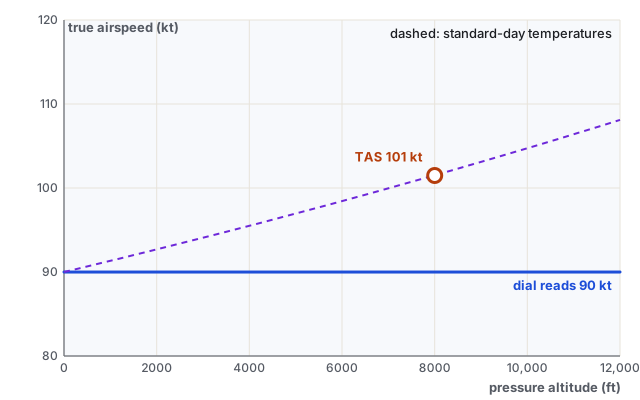 Also try
E6B true airspeed: why you’re faster than the dial says
The airspeed indicator feels air pressure, not speed. Thin air at altitude makes true airspeed higher.
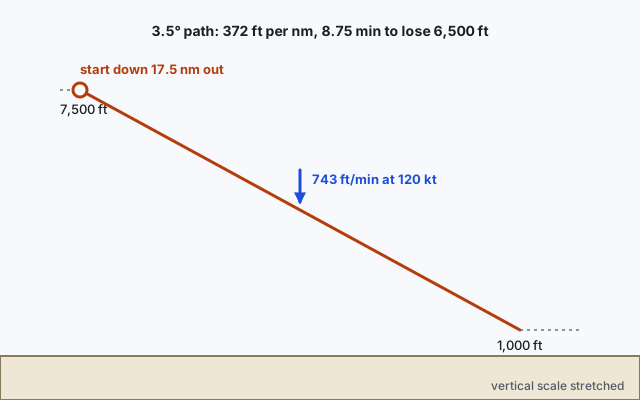 Also try
E6B descent planning: when to start down
A 3° path drops about 318 ft every nautical mile. Tangent turns that into a distance and a descent rate.
Questions people ask
How do you find the wind correction angle?
Find the crosswind, the wind speed times the sine of the angle between the wind and your course. Divide it by true airspeed and take the inverse sine. A 14 kt crosswind at 120 kt TAS is about 6.8°.
Why is groundspeed different from true airspeed?
True airspeed is your speed through the air. The air itself is moving with the wind, so over the ground you add a tailwind or subtract a headwind.
Is this the same as an E6B?
It solves the same wind triangle the E6B's wind side does. It's a study aid for checking your work, not an approved flight computer.