How do I adjust a torque wrench for a crowfoot or adapter?
Torque is force times lever length. An adapter that sticks out in line with the handle makes the lever longer than the wrench measures, so the fastener gets more than the setting. Set the wrench to the spec times L ÷ (L + E), where L is the wrench length and E is the adapter's reach.
- Set the wrench to
- 68.6 ft·lb
- Push at your hand
- 68.6 lbf
- If you set the spec instead, you’d get
- 93.3 ft·lb
Torque specs assume clean, dry threads unless the manual says otherwise. Oil or anti-seize can overtighten a lot at the same setting.
Challenge: Your wrench only goes to 50 ft·lb. Hit a spec of 60 ft·lb or more with it set at 50, using an adapter of at least 2 in.
Play
Try the crowfoot preset, then turn the adapter 90° by setting its reach to zero.
Challenge: Your wrench only goes to 50 ft·lb. Hit a spec of 60 ft·lb or more with it set at 50, using an adapter of at least 2 in. The box under the picture turns green when you get it.
Stuck? Pick one of the examples from the “Try an example” menu, or press “New example.”
Understand
Torque is force times distance from the pivot: . The curve shows it the other way around. The push you need falls as the lever gets longer, .
A torque wrench measures torque at its own head. Add a crowfoot or adapter that reaches out in line with the handle, and the real lever is . The nut gets more than the dial says, so set it lower:
Use
Every input has a unit menu, so you can type values in the units you already have. Results follow your units.
Show the work
- Torque = force × lever arm
\tau = F \times r - Push needed at your hand (the lever reaches from the nut to your hand)
F = \frac{T}{L + E} = \frac{80 \times 12}{14\ \text{in}} = 68.57\ \text{lbf} - The wrench measures only its own length, so scale the setting
S = 80\cdot\frac{12}{12 + 2} = 68.57\ \text{ft·lb} - Check: what the nut actually gets
68.57\cdot\frac{14}{12} = 80\ \text{ft·lb}
Export
Set the spec, the wrench length, and the adapter reach. With no adapter, you just see how hard to pull.
- Measure the wrench length from the center of the head to the middle of your grip, or use the length the manufacturer gives.
- Pull smoothly at a right angle to the handle. Jerking the wrench overshoots.
For learning and estimation. Verify with applicable codes, standards, and a qualified professional before using in design, construction, or safety-critical work.
Cheat card
| Symbol | Meaning | Unit |
|---|---|---|
| torque you need | ft·lb | |
| wrench length, head to hand | in | |
| adapter reach in line with the handle | in | |
| what to set the wrench to | ft·lb |
- Multiply ft·lb by 12 before dividing by inches.
- An adapter at 90° to the handle adds almost no lever, so no correction.
- Socket extensions straight down don't change the lever at all.
Where it’s used
- Mechanical
Aircraft and engine mechanics correct torque for crowfoot adapters on tube fittings every day. - Physics
Torque is the turning version of force. Seesaws, doors, and gears all run on force × distance. - Driving & Travel
Tighten lug nuts to spec after a tire change, and know how hard you have to pull.
Related exhibits
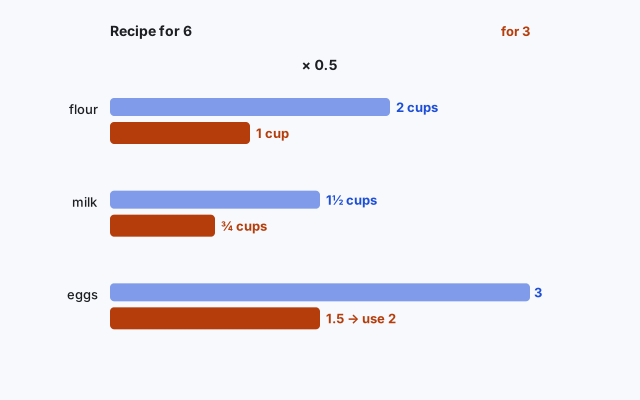 Start here
Scaling a recipe: more people, same taste
Double the guests? Every ingredient grows by the same factor.
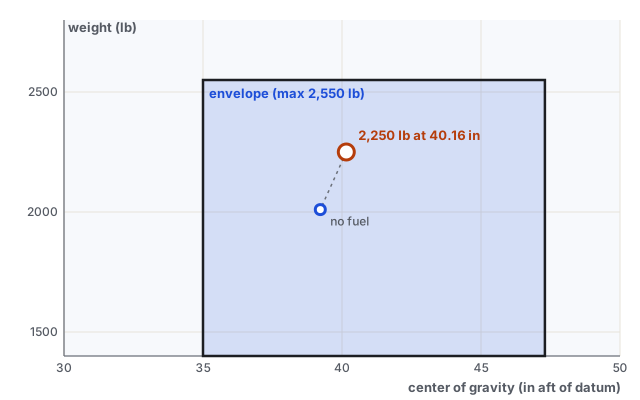 Go further
E6B weight and balance: where the center of gravity lands
The CG is a weighted average. Load people, bags, and fuel, and watch the dot move in the envelope.
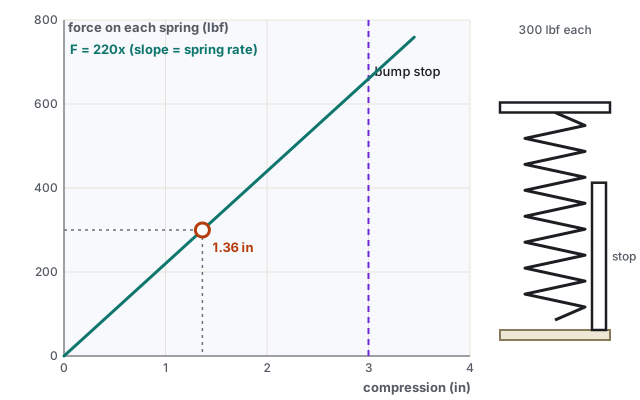 Also try
Hooke’s law: how far does the car sag when you load it?
A spring squeezes in a straight line with the load: twice the weight, twice the sag, until it hits the stops.
Questions people ask
What is torque?
A turning force, equal to the force times its distance from the pivot. Forty pounds pushed two feet from a bolt is 80 ft·lb.
Does a socket extension change torque?
A straight extension between the wrench and socket doesn't change the reading. Only an adapter that moves the bolt away from the wrench head, in line with the handle, changes it.
How hard do I pull to torque lug nuts?
Divide the torque by the handle length. 100 ft·lb on an 18 inch wrench is 100 × 12 ÷ 18, about 67 lb of push.