How do you convert indicated airspeed to true airspeed?
The airspeed indicator measures the push of the air, which depends on air density as well as speed. In thin air it reads low. True airspeed is calibrated airspeed divided by the square root of the density ratio. A quick rule adds about 2 percent per 1,000 feet of altitude.
- True airspeed
- 101 kt
- Faster than calibrated by
- 12.8%
- Density altitude
- 7980 ft
E6B: Training aid only, not for navigation or flight. Verify with your POH/AFM and approved sources.
Play
Climb from sea level to 10,000 ft at the same dial reading. Watch true airspeed rise.
Stuck? Pick one of the examples from the “Try an example” menu, or press “New example.”
Understand
The airspeed indicator is really a pressure gauge. It measures the dynamic pressure of the oncoming air. It's calibrated for sea-level density, so when the air is thinner it under-reads your true speed.
Setting the pressures equal gives
where comes from the standard atmosphere with a power of altitude and a temperature correction. The dashed curve is a standard day. Hotter air puts the dot above it.
Use
Every input has a unit menu, so you can type values in the units you already have. Results follow your units.
Show the work
- Density ratio from pressure altitude and temperature
\sigma = (1 - 6.8756\times10^{-6}\cdot8000)^{5.2559}\cdot\frac{288.15}{-1 + 273.15} = 0.7864 - The dial feels ½ρv², so true speed is scaled by 1/√σ
\text{TAS} = \frac{90}{\sqrt{0.7864}} = 101.5\ \text{kt} - Rule of thumb: +2% per 1,000 ft
90 \times (1 + 0.02 \times 8) = 104.4\ \text{kt}
Export
Enter calibrated airspeed, pressure altitude, and outside air temperature.
- Pressure altitude is what the altimeter reads with 29.92 set in the window.
- The result feeds straight into the wind triangle tool.
For learning and estimation. Verify with applicable codes, standards, and a qualified professional before using in design, construction, or safety-critical work.
Cheat card
| Symbol | Meaning | Unit |
|---|---|---|
| calibrated airspeed (indicated, corrected) | kt | |
| air density ÷ sea-level standard density | ||
| pressure altitude | ft |
- Use true airspeed in the wind triangle, never indicated.
- Stall speeds in the POH are indicated, so they stay the same at altitude even though TAS is higher.
- Above about 200 kt, air compresses and needs an extra correction not included here.
Where it’s used
Related exhibits
 Start here
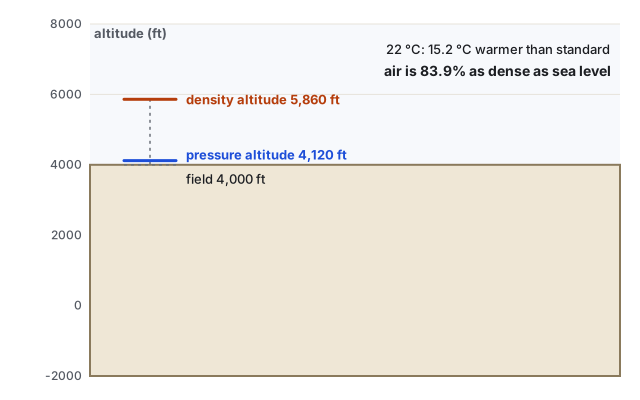
E6B density altitude: how high the airplane thinks it is
Hot, high, and low pressure thin the air. Density altitude says how much, in feet.
 Go further
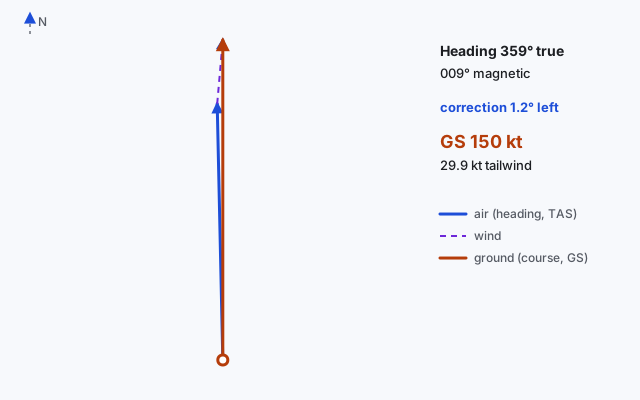
E6B wind triangle: heading and groundspeed
Point the nose into the wind just enough to track your course. Three vectors, one triangle.
 Also try
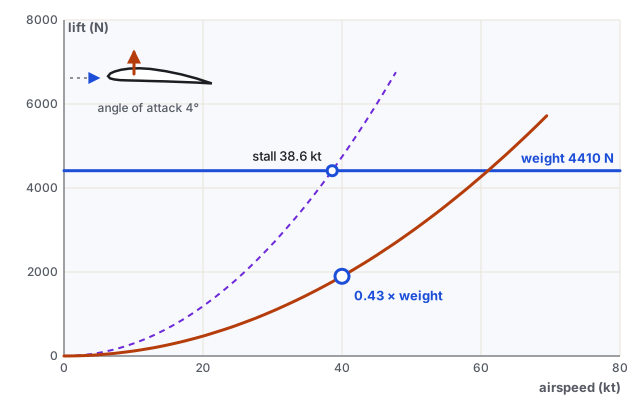
Wing lift: why twice the speed means four times the lift
Lift grows with airspeed squared. Bernoulli, angle of attack, thin air, and the stall, all on one curve.
 Also try
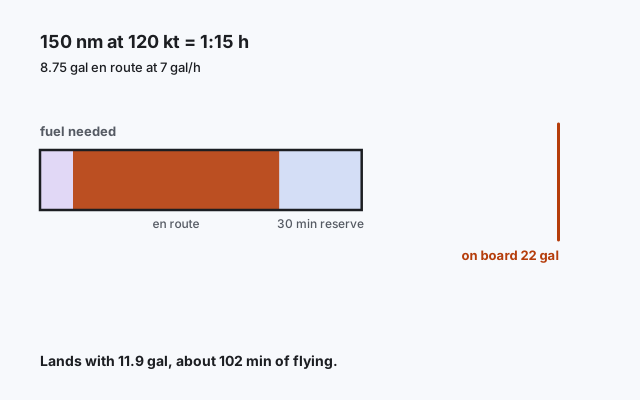
E6B time and fuel: will it make it with a reserve?
Distance over groundspeed gives time; time times burn gives fuel. Then leave something in the tanks.
Questions people ask
Why is true airspeed higher than indicated at altitude?
The indicator senses the pressure of oncoming air, ½ρv². Higher up, density ρ is lower, so the airplane must move faster to make the same pressure. The dial shows the same number while you actually go faster.
How much faster is true airspeed?
About 2% per 1,000 ft. At 8,000 ft on a standard day, 110 kt calibrated is about 124 kt true.
What's the difference between indicated and calibrated airspeed?
Calibrated corrects indicated airspeed for errors in the pitot-static system, using a table in the POH. In cruise the two are usually within a few knots.