How do you calculate an airplane's center of gravity?
Multiply each weight by its arm, the distance from a reference point called the datum, to get its moment. Add up the moments and the weights, then divide total moment by total weight. That weighted average is the center of gravity, and it has to fall inside the envelope in your airplane's handbook.
- Takeoff weight
- 2250 lb
- Center of gravity
- 40.2 in
- Total moment
- 90,400 lb·in
- Room left under max weight
- 300 lb
Real envelopes usually aren’t rectangles: the forward limit often moves aft at heavier weights. Check your POH chart.
E6B: Training aid only, not for navigation or flight. Verify with your POH/AFM and approved sources.
More settings
Play
Put a light pilot up front and heavy bags in back. Watch the dot slide aft.
Stuck? Pick one of the examples from the “Try an example” menu, or press “New example.”
Understand
The center of gravity is a weighted average of where the weight sits. Each item pulls the balance point toward its own arm in proportion to its weight:
The shaded box is the loading envelope. The large dot is takeoff, and the small dot is the same load with the fuel gone. The line between them is the path the CG takes as fuel burns.
Use
Every input has a unit menu, so you can type values in the units you already have. Results follow your units.
Show the work
- Fuel weight
40\ \text{gal} \times 6\ \text{lb/gal} = 240\ \text{lb} - Moment = weight × arm, for each item
1650\times39 + 340\times37 + 0\times73 + 20\times95 + 240\times48 = 90{,}350 - Total weight
\sum w = 2250\ \text{lb} - Center of gravity
\text{CG} = \frac{90{,}350}{2250} = 40.16\ \text{in}
Export
Set the loads and fuel. Open "More settings" to enter your own airplane's empty weight, arms, and limits. The defaults are an example trainer about the size of a Cessna 172. These are not its real numbers. Use your own airplane's weight-and-balance record and POH.
- Arms and limits must come from your airplane's POH and weight-and-balance record.
- Jet fuel weighs about 6.7 lb/gal. This tool assumes avgas.
For learning and estimation. Verify with applicable codes, standards, and a qualified professional before using in design, construction, or safety-critical work.
Cheat card
| Symbol | Meaning | Unit |
|---|---|---|
| weight of an item | lb | |
| distance aft of the datum | in | |
| center of gravity | in |
- Check the CG at takeoff and with the fuel burned off. Both must be in the envelope.
- An aft CG makes the airplane less stable and can make stall recovery hard or impossible.
- Use your airplane's own empty weight and arms. They change with equipment installed.
Where it’s used
Related exhibits
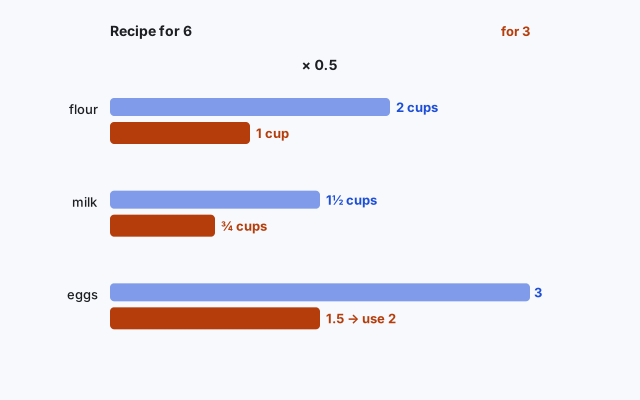 Start here
Scaling a recipe: more people, same taste
Double the guests? Every ingredient grows by the same factor.
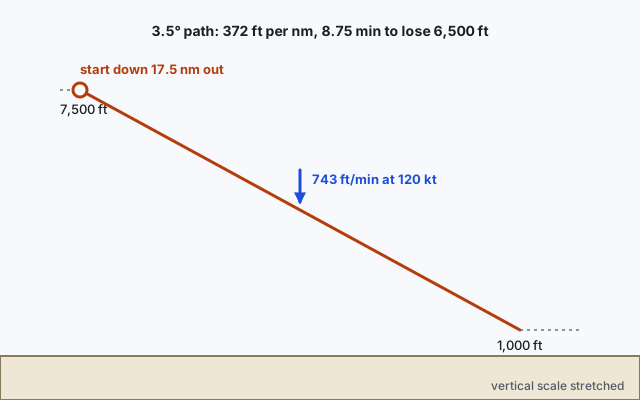 Go further
E6B descent planning: when to start down
A 3° path drops about 318 ft every nautical mile. Tangent turns that into a distance and a descent rate.
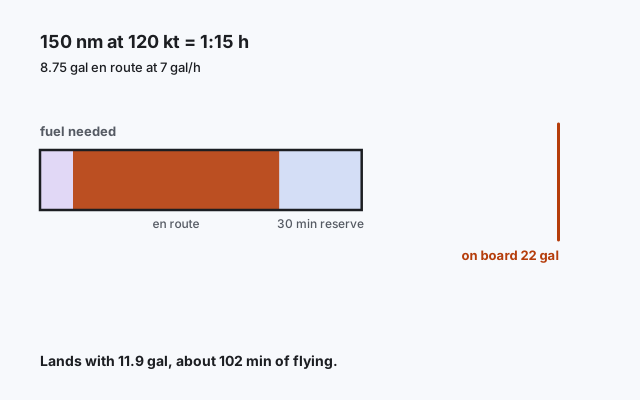 Also try
E6B time and fuel: will it make it with a reserve?
Distance over groundspeed gives time; time times burn gives fuel. Then leave something in the tanks.
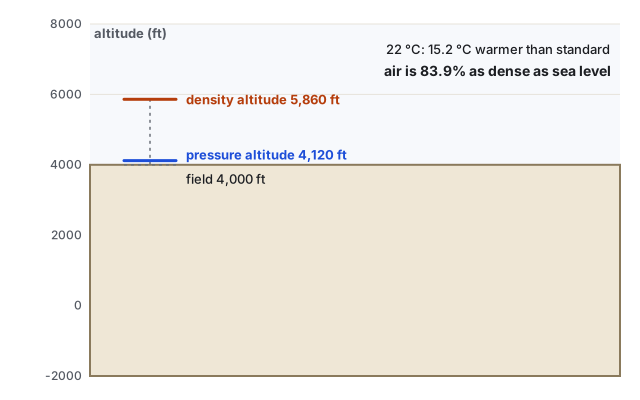 Also try
E6B density altitude: how high the airplane thinks it is
Hot, high, and low pressure thin the air. Density altitude says how much, in feet.
Questions people ask
How do you calculate center of gravity for an airplane?
For each item, weight × arm = moment. Add the weights and add the moments. CG = total moment ÷ total weight. Then check that the weight and CG fall inside the POH envelope.
What happens if the CG is out of limits?
Forward of the limit, the airplane may not rotate or flare properly. Aft of the limit, it becomes unstable and stall recovery can be impossible. Never fly outside the envelope.
Why check the CG with no fuel?
Fuel burns off during the flight, moving the CG. If the zero-fuel point leaves the envelope, the airplane could go out of limits before landing.