What is the rule of thumb for density altitude?
Start with pressure altitude: field elevation plus (29.92 minus the altimeter setting) times 1,000. Find the standard temperature there, 15 °C minus 2 °C per 1,000 feet. Then add 120 feet for every degree Celsius the air is warmer than standard, or subtract it when colder.
- Density altitude (rule of thumb)
- 5950 ft
- Pressure altitude
- 4120 ft
- Standard temperature there
- 6.76 °C
E6B: Training aid only, not for navigation or flight. Verify with your POH/AFM and approved sources.
Play
Warm the day up one degree at a time and count 120 feet each step.
Stuck? Pick one of the examples from the “Try an example” menu, or press “New example.”
Understand
Density altitude is a straight-line linear correction, twice:
- Pressure: each inch of mercury below 29.92 adds 1,000 ft.
- Temperature: each degree Celsius above standard adds 120 ft.
The real atmosphere isn't linear. Density falls with a power of altitude. But over the few thousand feet that matter for takeoff, a straight line fits well enough to do in your head.
Use
Every input has a unit menu, so you can type values in the units you already have. Results follow your units.
Show the work
- Pressure altitude: 1,000 ft per inch of mercury
\text{PA} = 4000 + (29.92 - 29.8) \times 1000 = 4120\ \text{ft} - Standard temperature: 15 °C, minus 2 °C per 1,000 ft
T_{\text{ISA}} = 15 - 2 \times \frac{4120}{1000} = 6.76\ ^\circ\mathrm{C} - Add 120 ft per °C above standard
\text{DA} \approx 4120 + 120 \times (22 - 6.76) = 5949\ \text{ft}
Export
Enter field elevation, the altimeter setting, and the temperature. For the exact answer, including humidity, open the exact density altitude tool linked above.
- Use POH performance charts with pressure altitude and temperature for real takeoff and climb numbers.
For learning and estimation. Verify with applicable codes, standards, and a qualified professional before using in design, construction, or safety-critical work.
Cheat card
| Symbol | Meaning | Unit |
|---|---|---|
| pressure altitude | ft | |
| outside air temperature | °C | |
| standard temperature at that altitude | °C |
- Each 0.01 inHg below 29.92 adds about 10 ft of pressure altitude.
- The rule runs a little high on hot days compared with the exact formula, which errs on the safe side.
- Humidity isn't in the rule. On humid days, the exact tool with dew point gives a higher answer.
Where it’s used
- Aerospace
Pilots use the 120-feet-per-degree rule for a quick density altitude check before takeoff. - Driving & Travel
It explains why summer afternoons at mountain airports feel like flying thousands of feet higher.
Related exhibits
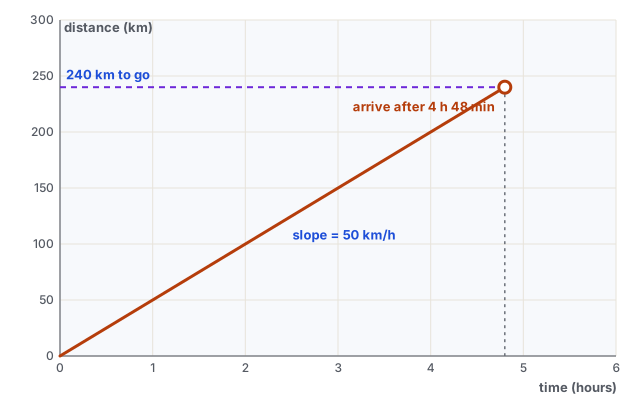 Start here
Speed, distance, time: how long is the drive?
Distance is speed times time. Rearrange it and you know when you’ll arrive.
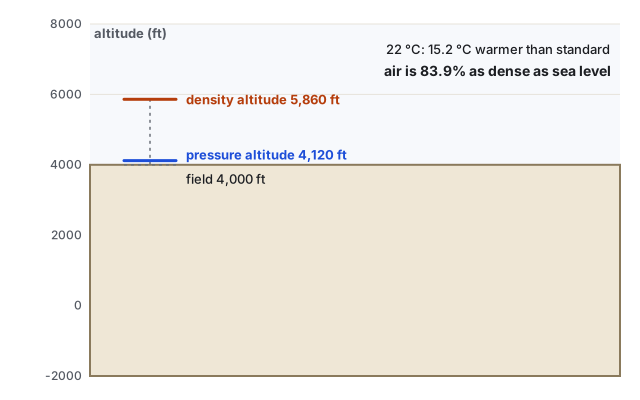 Go further
E6B density altitude, exact: standard atmosphere and humidity
The full standard-atmosphere formula, plus the dew point. Humid air is lighter, so it flies higher.
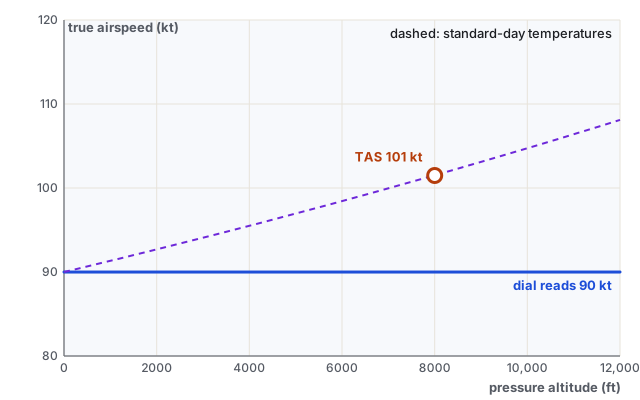 Go further
E6B true airspeed: why you’re faster than the dial says
The airspeed indicator feels air pressure, not speed. Thin air at altitude makes true airspeed higher.
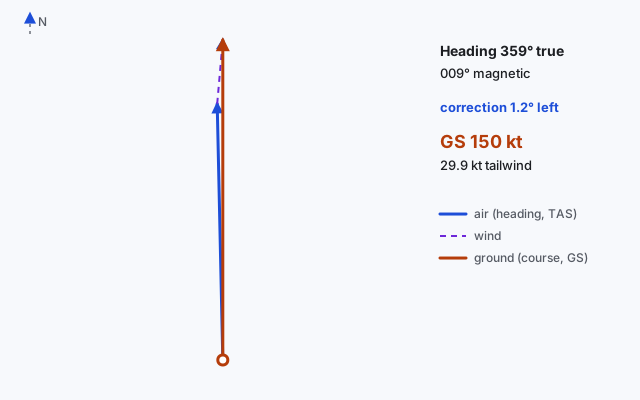 Also try
E6B wind triangle: heading and groundspeed
Point the nose into the wind just enough to track your course. Three vectors, one triangle.
 Also try
Wing lift: why twice the speed means four times the lift
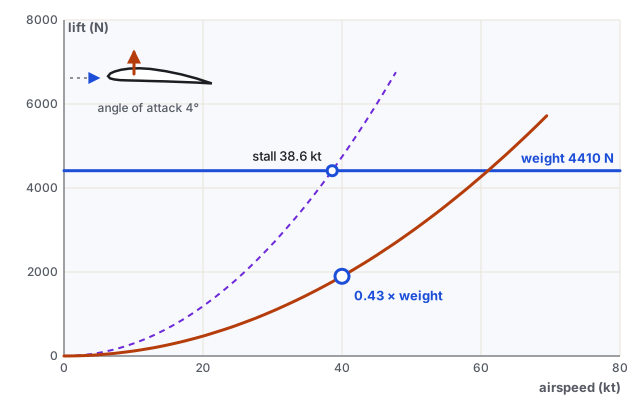
Lift grows with airspeed squared. Bernoulli, angle of attack, thin air, and the stall, all on one curve.
Questions people ask
What is the density altitude rule of thumb?
Density altitude ≈ pressure altitude + 120 × (OAT − standard temperature). Standard temperature is 15 °C at sea level, dropping 2 °C per 1,000 ft.
How accurate is the rule of thumb?
Within a few hundred feet for typical conditions. On a 30 °C day in Denver it gives about 8,290 ft, versus about 8,080 ft from the exact dry-air formula. That's a slightly conservative result.
Where does 120 feet per degree come from?
Near the ground, a 1 °C rise in temperature thins the air about as much as climbing roughly 120 ft in the standard atmosphere. It's a straight-line fit to the exact curve.