How much is advantage worth on a d20?
Advantage means rolling two d20s and keeping the higher, so you only fail if both dice fail. When you need an 11, that raises your chance from 50% to 75%, the same as a +5 bonus. Near the edges it's worth much less: needing a 20, advantage adds under 5 points of chance, about +1.
- Chance to succeed
- 64%
- Same as a flat bonus of
- 4.8
- Chance of a natural 20
- 9.75%
- Average roll kept
- 13.8
Challenge: Find the target where advantage is worth exactly +5.
Play
Slide the target from 2 to 20 with advantage on, and watch the bonus peak in the middle.
Challenge: Find the target where advantage is worth exactly +5. The box under the picture turns green when you get it.
Stuck? Pick one of the examples from the “Try an example” menu, or press “New example.”
Understand
With advantage, you only fail if both dice fail. Each die misses with probability , and both miss with that number squared, so
The bars show how likely each kept roll is. A normal d20 is flat, 5% for every face. With advantage the bars lean right: high rolls become more likely. Orange bars are the rolls that succeed. The big number converts the gain into a flat bonus, since each point of bonus is one more face out of 20.
Use
Every input has a unit menu, so you can type values in the units you already have. Results follow your units.
Show the work
- One d20 reaches the target on these faces
\frac{20 - 13 + 1}{20} = 0.4 - Advantage: you only miss if every die misses, so subtract that from 1
P(\ge 13) = 1 - \left(\frac{12}{20}\right)^{2} = 0.64 - Each point of bonus adds 5% (one face of 20), so the same gain as a flat bonus is
(0.64 - 0.4) \times 20 = 4.8
Export
Set the number you need on the die (subtract your modifier from the DC) and pick how you roll.
- These are the dice alone. Bonuses, rerolls, and special rules on a 1 or a 20 change the totals.
For learning and estimation. Verify with applicable codes, standards, and a qualified professional before using in design, construction, or safety-critical work.
Cheat card
| Symbol | Meaning | Unit |
|---|---|---|
| the number you need on the die |
- Advantage helps most when you have a coin-flip chance. When you'd almost always hit, or almost never, it barely matters.
- A natural 20 goes from 5% to 9.75% with advantage, almost double.
- Disadvantage hurts by the same amount advantage helps, at every target.
Where it’s used
- Computer Science
Game designers use roll-twice-keep-one rules to make luck feel better without changing the dice. - Hobbies & Crafts
Tabletop players weigh spending a turn to gain advantage against just making the attack. - Hobbies & Crafts
Rogues and spellcasters plan around advantage because it nearly doubles critical hits.
Related exhibits
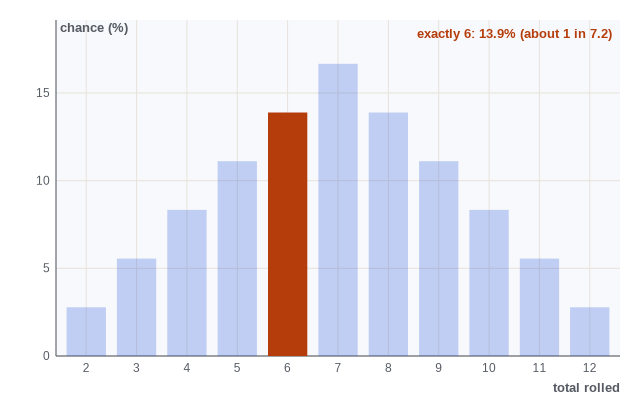 Start here
Dice odds: what are my chances of rolling it?
Why 7 shows up so often with two dice, and what that means for your next move.
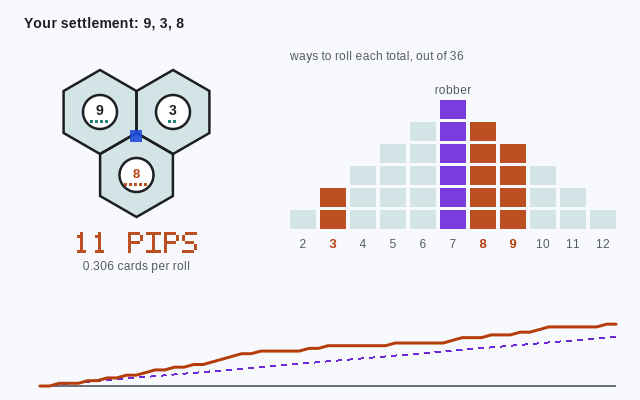 Go further
Catan dice: which settlement spots really pay?
Two dice make 7 most often and 2 or 12 least. Count the pips on a spot and you know how many cards it will hand you.
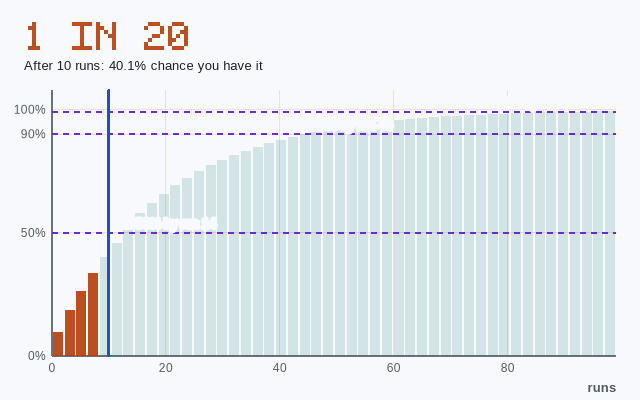 Also try
Loot drops: why a 1% drop doesn’t mean 100 tries
Each run is a fresh roll, so after 100 tries at 1% over a third of players still have nothing. A pity timer is the fix.
Questions people ask
Is advantage the same as +5?
Only when you need around an 11. The bonus it's equal to depends on the target. It's +5 in the middle and shrinks toward +1 at the ends.
How does advantage change my chance of a natural 20?
It nearly doubles it, from 5% to 9.75%. You crit if either die shows 20, and 1 − (19/20)² is 9.75%.
What does rolling three dice and keeping the highest add?
Your chance of missing becomes the miss chance cubed. Needing an 11 goes from 75% to 87.5%, and a natural 20 rises to about 14.3%.
Updated : First published.