How does an Elo rating predict who will win?
Elo turns the rating gap into odds: every 400 points multiplies the favorite's odds by ten. Two equal players are 50-50, a 200-point edge is about 76%, and 400 points is about 91%. After each game, ratings move by the K-factor times the surprise, so upsets earn more points than expected wins.
- Your chance to win (expected score)
- 84.9%
- Points if you win
- 4.83
- Points if you lose
- -27.2
- Chance to win the series
- 97.3%
Chess uses Elo directly. Many online games use relatives of it, like Glicko or TrueSkill, that also track how certain a rating is, so their exact numbers differ.
Challenge: Find the rating gap that makes the favorite a 90% pick.
More settings
Play
Set yourself 200 points above, then flip it. Watch how many points a win is worth each way.
Challenge: Find the rating gap that makes the favorite a 90% pick. The box under the picture turns green when you get it.
Stuck? Pick one of the examples from the “Try an example” menu, or press “New example.”
Understand
Elo treats the rating gap as a power of ten: every 400 points multiplies the odds by 10. Turning odds into a chance gives the expected score:
That's an S-shaped curve, drawn here as a staircase: steep near an even match and flat at the ends. After a game, each rating moves by , the K-factor times the surprise. Beat the favorite and the surprise is big, so the points are too.
Use
Every input has a unit menu, so you can type values in the units you already have. Results follow your units.
Show the work
- Every 400 points of gap multiplies the odds by 10
\text{odds} = 10^{(1600 - 1300)/400} = 5.623 - Turn the odds into a chance
E = \frac{1}{1 + 10^{-(1600 - 1300)/400}} = 0.849 - After the game, move K × (actual − expected)
\text{win: } 32(1 - 0.849) = 4.83,\quad \text{lose: } 32(0 - 0.849) = -27.2 - Best of 5: add up the chances of winning a majority (binomial)
P = \sum_{w=3}^{5} \binom{5}{w} E^w (1 - E)^{5 - w} = 0.9729
Export
Set the two ratings. "More settings" picks the K-factor and a series length, which shows how a longer match magnifies a small edge.
- Real systems add details like provisional ratings and rating floors.
For learning and estimation. Verify with applicable codes, standards, and a qualified professional before using in design, construction, or safety-critical work.
Cheat card
| Symbol | Meaning | Unit |
|---|---|---|
| the two ratings | ||
| expected score, win chance | ||
| actual score: 1 win, ½ draw, 0 loss | ||
| how fast ratings move |
- What the two players gain and lose always adds to zero, so ratings just trade points.
- A big K reacts fast for new players. A small K keeps established ratings steady.
- A longer series favors the better player. A 60% edge per game wins a best of 7 about 71% of the time.
Where it’s used
- Computer Science
Online games use rating systems built on Elo to make matches that feel close. - Hobbies & Crafts
Chess federations and sites like chess.com rate players with Elo or close relatives. - Sports & Games
Sports analysts rate teams with Elo to forecast games and playoff chances.
Related exhibits
 Start here
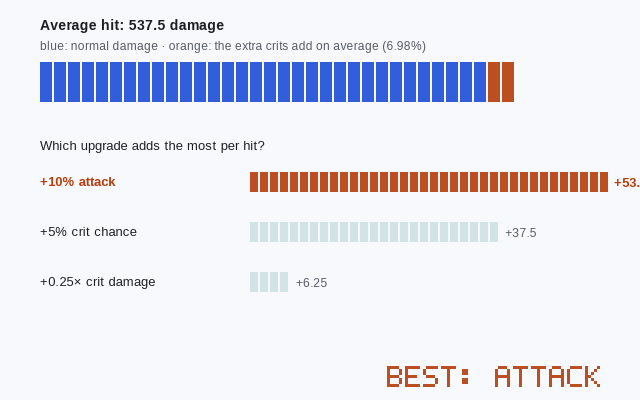
Crit chance vs. crit damage: which upgrade hits harder?
Your average hit is damage × (1 + chance × (multiplier − 1)). Compare upgrades on that one number and the best pick is obvious.
 Go further
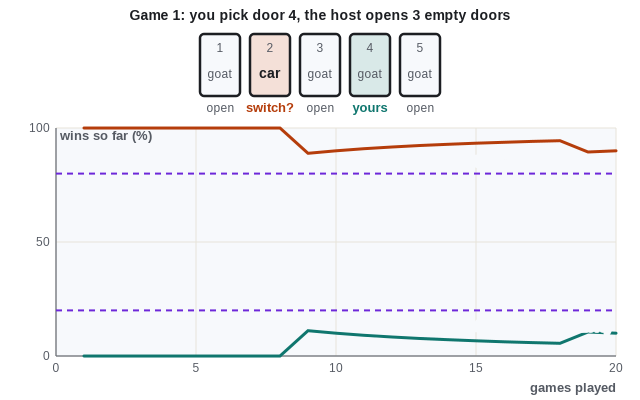
Monty Hall: should you switch doors?
Pick a door, watch the host open an empty one, then decide. Switching wins two times out of three, and here you can watch it happen.
 Also try
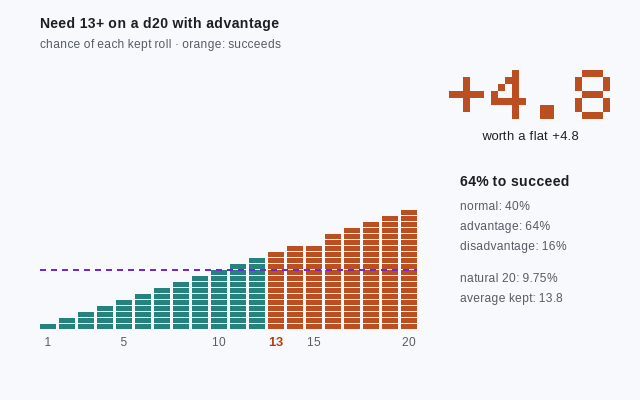
Advantage on a d20: how much is rolling twice worth?
Roll two d20s and keep the higher. It’s worth about +5 when you need an 11, but only +1 when you need a 20.
 Also try
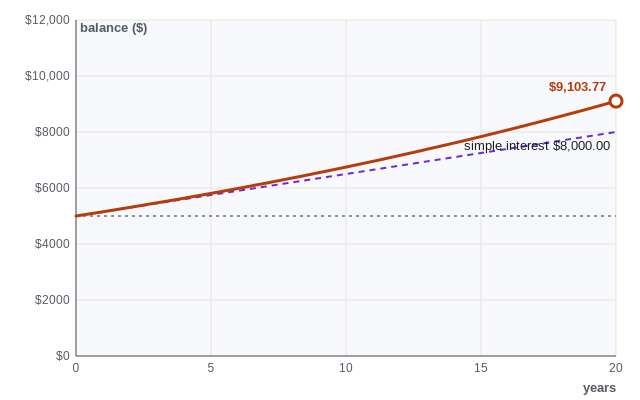
Compound interest: money that grows on itself
Interest earns interest. Exponents explain why saving early wins.
Questions people ask
What does a 400-point rating difference mean?
The higher-rated player is expected to score about 10 to 1, around 91%. Every 400 points multiplies the odds by ten.
Why do I gain fewer points for beating a weaker player?
Because you were expected to win. You move by K times the difference between the result and the expectation, and a likely win is only a small surprise.
What is a K-factor?
The most points a single game can move a rating. New players use a higher K so their rating finds its level quickly.
Updated : First published.