How do video games decide how high a character jumps?
A game gives the jump an upward speed, and gravity takes some away every moment until the character stops at the top and falls. The height works out to the speed squared divided by twice the gravity. Designers tune those two numbers, and many make you fall faster than you rise so the jump feels tight.
- Jump height
- 7.5 tiles
- Time in the air
- 1.82 s
- Distance covered
- 18.2 tiles
Challenge: Make a snappy jump at least 4 tiles high that's in the air for under 0.8 seconds.
More settings
Play
Press "Run it" on the floaty preset, then on the snappy one. Feel the difference?
Challenge: Make a snappy jump at least 4 tiles high that's in the air for under 0.8 seconds. The box under the picture turns green when you get it.
Stuck? Pick one of the examples from the “Try an example” menu, or press “New example.”
Understand
A jump starts with an upward speed . Every second, gravity takes away, so the character rises for seconds, stops, and falls. The height is a quadratic:
Press "Run it" to watch the hero follow the curve. The dots are the path, and the dashed line marks the top. With the fall multiplier in "More settings" above 1, gravity is stronger on the way down, so the curve is steeper on the right side. That's the trick that makes jumps feel tight.
Use
Every input has a unit menu, so you can type values in the units you already have. Results follow your units.
Show the work
- Gravity slows the jump until it stops at the top
t_{up} = \frac{v}{g} = \frac{15}{15} = 1\ \text{s} - The height is a quadratic: speed squared over twice gravity
h = \frac{15^2}{2 \times 15} = 7.5\ \text{tiles} - Falling with 1.5× gravity from the top
t_{down} = \frac{v}{g\sqrt{m}} = \frac{15}{15\sqrt{1.5}} = 0.8165\ \text{s} - Distance while running
10 \times 1.816 = 18.16\ \text{tiles}
Export
Set the jump speed and gravity. "More settings" adds the faster fall and a running speed, which shows how far the jump carries you.
- Game engines run this math for you every frame. Knowing it lets you design levels that fit the jump.
For learning and estimation. Verify with applicable codes, standards, and a qualified professional before using in design, construction, or safety-critical work.
Cheat card
| Symbol | Meaning | Unit |
|---|---|---|
| jump speed straight up | tiles/s | |
| gravity | tiles/s² | |
| extra gravity while falling | × |
- Double the jump speed and the jump gets four times as high. That's the square at work.
- Strong gravity with a fast jump feels snappy. Weak gravity with a slow jump feels floaty, like the Moon.
- Lots of games add extra gravity on the way down so you're not left hanging in the air.
Where it’s used
- Computer Science
Game designers tune jump speed and gravity until the controls feel right, then build the levels around that jump. - Physics
Real thrown objects follow the same curve. Games just pick their own gravity. - Hobbies & Crafts
Speedrunners know exactly how many tiles a jump clears and plan their routes around it.
Related exhibits
 Start here
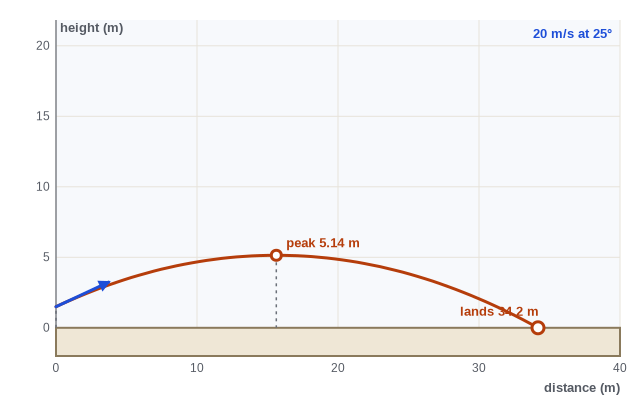
Throwing a ball: the quadratic arc
Every throw, jump, and fountain draws a parabola.
 Go further
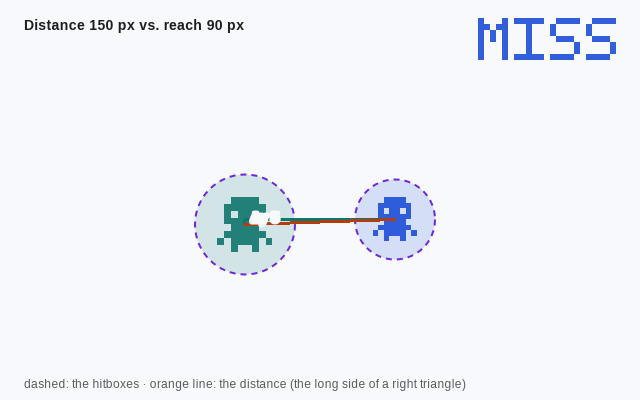
Hitboxes: how a game knows you got hit
Games wrap every character in an invisible circle or box. A hit is just a distance check, and the Pythagorean theorem does the work.
 Also try
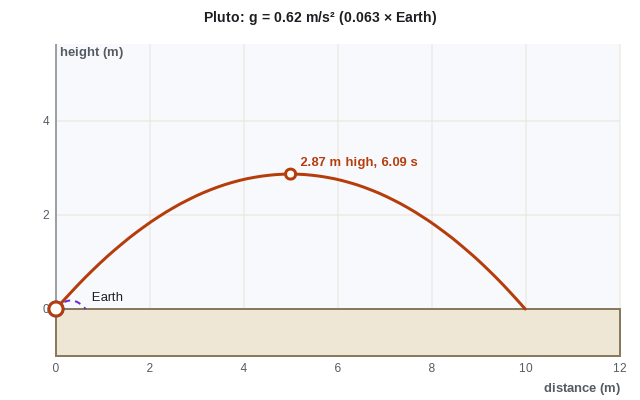
Jumping on the Moon: the same leap on other worlds
Same legs, same launch. Weaker gravity stretches the parabola, and the motion plays in real time.
 Also try
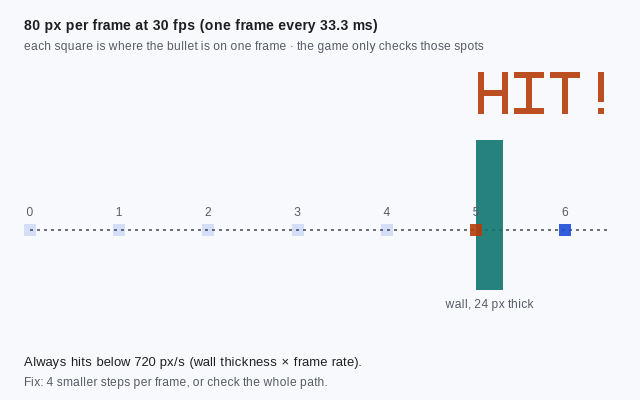
Why fast bullets pass through walls: tunneling
Games move things in jumps, one per frame. If a bullet jumps farther than the wall is thick, it can skip right over it.
Questions people ask
Why do some game jumps feel floaty?
Low gravity and a slow jump keep you in the air a long time at the top. Many games fix it by making gravity stronger on the way down.
Do games use real gravity?
Rarely. If one tile is a meter, real gravity is 9.8 tiles/s², which feels slow and floaty in a game. Platformers often use several times that.
Why is jump height a square?
Faster jumps go up for longer and also cover more ground each moment, so the height grows with the speed times itself.
Updated : First published.