Why do you slide so far on ice levels in video games?
Many games slow you down by keeping a fraction of your speed every frame. On grass that might be 85%, so you stop almost at once. On ice it's 98%, and the tiny leftover steps add up, so you slide almost nine times as far. The total is a geometric series: v × Δt × f ÷ (1 − f).
- Slides this far before stopping
- 1.27 tiles
- Time to stop
- 1.43 s
- Frames until speed halves
- 13.5
Challenge: Starting at 6 tiles per second, slide at least 10 tiles.
More settings
Play
Press "Run it: let go of the stick" on grass, then on ice. Then nudge the friction from 98% to 99%.
Challenge: Starting at 6 tiles per second, slide at least 10 tiles. The box under the picture turns green when you get it.
Stuck? Pick one of the examples from the “Try an example” menu, or press “New example.”
Understand
Each frame, the game keeps a share of your speed, so after frames you're moving at , an exponential decay. You keep moving a little every frame, and the distance adds up to a geometric series:
The bars show your speed shrinking frame by frame. Close to 100%, the on the bottom gets tiny, and the slide gets enormous. Press "Run it" to watch the hero slide to a stop.
Use
Every input has a unit menu, so you can type values in the units you already have. Results follow your units.
Show the work
- Each frame, speed is multiplied by the friction factor
v_1 = 4 \times 0.95,\ v_2 = 4 \times 0.95^2,\ \ldots - Distance per frame is speed × frame time, so the total is a geometric series
d = v_0\,\Delta t\,(f + f^2 + f^3 + \cdots) = v_0\,\Delta t\,\frac{f}{1 - f} - With your numbers
d = 4 \times \frac{1}{60} \times \frac{0.95}{1 - 0.95} = 1.267\ \text{tiles} - Frames until speed halves: solve fⁿ = ½ with logarithms
n = \frac{\ln 0.5}{\ln 0.95} = 13.5
Export
Set the friction and the speed when you let go. "More settings" changes the frame rate.
- Real game engines often use smoother friction formulas, but the "keep a fraction each step" idea is the same.
For learning and estimation. Verify with applicable codes, standards, and a qualified professional before using in design, construction, or safety-critical work.
Cheat card
| Symbol | Meaning | Unit |
|---|---|---|
| share of speed kept each frame | ||
| speed when you let go | tiles/s | |
| time per frame | s |
- Going from 98% to 99% doubles the slide. Near 100%, small changes are huge.
- The slide is a geometric series. It adds up forever but to a finite total, because each step is smaller than the last.
- Good games scale friction by the frame time so a fast computer doesn't slide farther than a slow one.
Where it’s used
- Computer Science
Platformers tune per-frame friction separately for ground, ice, and air so each feels different. - Physics
Air resistance and cooling follow the same kind of decay, losing a fixed share each moment. - Hobbies & Crafts
Players feel the difference instantly: a few percent changes a level from easy to treacherous.
Related exhibits
 Start here
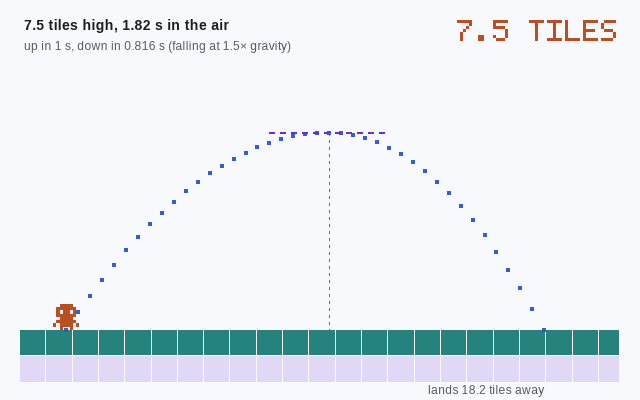
Tuning a platformer jump: why some jumps feel floaty
Jump height is speed² ÷ 2 × gravity. Game designers tune those two numbers, and often make you fall faster than you rise, so the jump feels just right.
 Go further
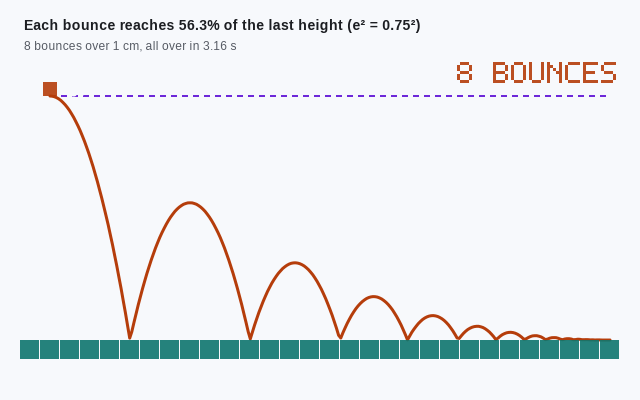
Bounce: how many bounces until it stops?
Every bounce keeps a share of the speed, so each one is a fixed fraction of the last. The bounces never quite end, yet the ball still stops in a few seconds.
 Also try
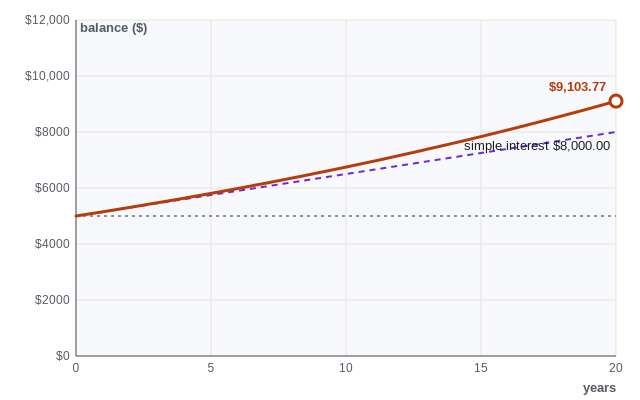
Compound interest: money that grows on itself
Interest earns interest. Exponents explain why saving early wins.
 Also try
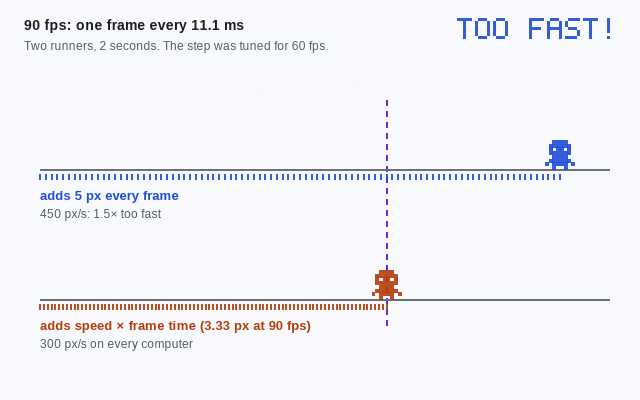
Frame rate: why some games go slow-mo when they lag
Move 5 pixels every frame and your speed depends on the frame rate. Multiply by the time per frame instead, and every computer runs the same speed.
Questions people ask
Why does ice make you slide so far?
Each frame you keep almost all your speed, so you shrink only a little at a time. Those small steps add up to a long slide.
What's a geometric series?
A sum where each term is the last one times the same number, like 1 + 0.9 + 0.81 + …. If that number is under 1, the sum settles to a total.
Why do some games feel different at different frame rates?
If friction is applied per frame without scaling by frame time, more frames per second means more slowing per second. Well-built games adjust for it.
Updated : First published.