Is crit chance or crit damage better?
Turn your stats into one number, the average damage per hit: damage times one plus crit chance times the extra a crit adds. Then check each upgrade's gain on that number. With few crits, more chance usually wins; with crits nearly guaranteed, more crit damage wins; and plain attack boosts everything at once.
- Average damage per hit
- 538
- Share of damage from crits
- 6.98%
- Best upgrade adds (per hit)
- 53.8
Games stack bonuses differently (some add, some multiply), and defense or resistances can change which upgrade wins. Use your game’s exact rules for close calls.
Challenge: Find a build where +5% crit chance beats +10% attack.
More settings
Play
Try the glass cannon preset, then slide crit chance up and watch the best upgrade change.
Challenge: Find a build where +5% crit chance beats +10% attack. The box under the picture turns green when you get it.
Stuck? Pick one of the examples from the “Try an example” menu, or press “New example.”
Understand
Every hit does damage. A crit, which happens with chance , does times as much, so it adds . Averaged over many hits, that's an expected value:
The top bar shows that average in blocks: blue is normal damage and orange is the extra crits add. Each upgrade raises the average by a different amount. Crit chance pays more when crits are big, and crit damage pays more when crits are common.
Use
Every input has a unit menu, so you can type values in the units you already have. Results follow your units.
Show the work
- Average hit: every hit does the base, and a crit adds (m − 1) more, c of the time
\bar{D} = 500\,\bigl(1 + 0.05\,(2.5 - 1)\bigr) = 537.5 - More attack scales the whole average
537.5 \times 0.1 = 53.75 - More crit chance adds the crit bonus a little more often
500 \times 0.05 \times (2.5 - 1) = 37.5 - More crit damage makes each crit bigger, but only c of the time
500 \times 0.05 \times 0.25 = 6.25
Export
Set your damage, crit chance, and crit multiplier. "More settings" changes the size of each upgrade you're comparing, to match the gear in your game.
- Defense, resistances, and how your game stacks bonuses can shift close calls.
For learning and estimation. Verify with applicable codes, standards, and a qualified professional before using in design, construction, or safety-critical work.
Cheat card
| Symbol | Meaning | Unit |
|---|---|---|
| damage per normal hit | ||
| crit chance | ||
| crit multiplier | × |
- Crit chance is worth more the bigger your crits are. Crit damage is worth more the more often you crit.
- Balance usually beats stacking one. Many players aim for crit damage about twice their crit rate.
- Average damage hides the swings. Low crit chance means some fights get no crits at all.
Where it’s used
- Computer Science
Game designers tune crit rates and multipliers so builds stay balanced and fights feel exciting. - Hobbies & Crafts
RPG and gacha players compare gear with expected damage instead of trusting the biggest number. - Hobbies & Crafts
The same expected-value math tells you which card upgrade helps most in a deck-builder.
Related exhibits
 Start here
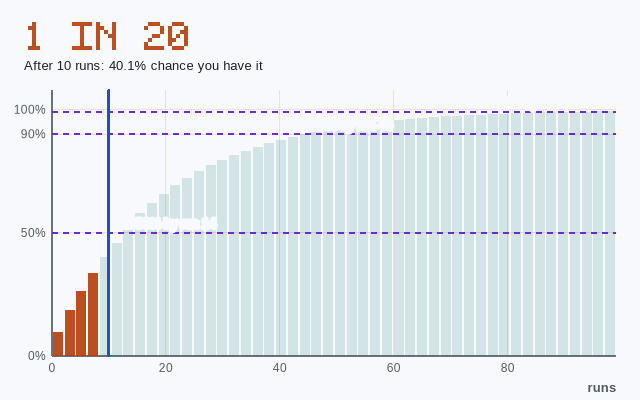
Loot drops: why a 1% drop doesn’t mean 100 tries
Each run is a fresh roll, so after 100 tries at 1% over a third of players still have nothing. A pity timer is the fix.
 Go further
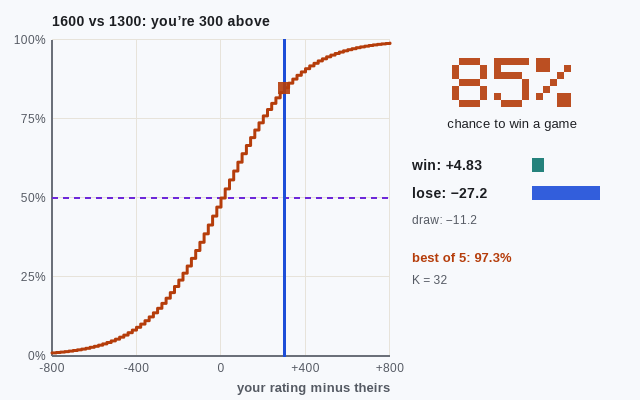
Elo ratings: how matchmaking predicts who wins
Every 400 points of rating gap multiplies the odds by 10. Beat someone better and you take more of their points.
 Also try
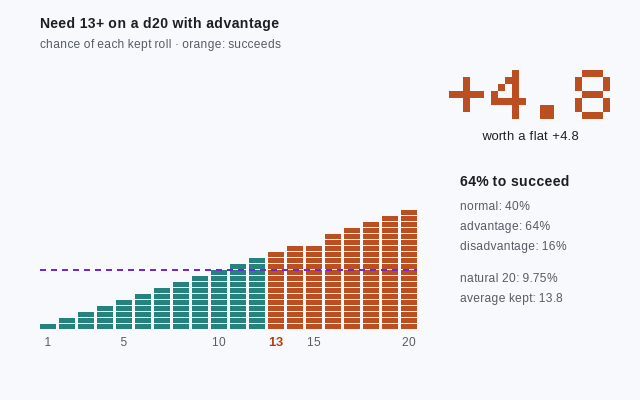
Advantage on a d20: how much is rolling twice worth?
Roll two d20s and keep the higher. It’s worth about +5 when you need an 11, but only +1 when you need a 20.
Questions people ask
How do I calculate average damage with crits?
Multiply your damage by one plus crit chance times the extra a crit adds. With 100 damage, 25% crits, and ×2 crits, that's 100 × (1 + 0.25 × 1) = 125.
Why does crit damage do nothing at 0% crit chance?
Crit damage only applies when you crit. At 0% chance it multiplies nothing, so raise chance first.
Is expected damage the whole story?
It's the average over many hits. Over a short fight, luck matters, and a low-crit build can go several hits without one.
Updated : First published.