How do games decide how a ball bounces?
Games give every object a bounciness between 0 and 1. Each bounce keeps that share of the speed, so the ball rises to that number squared times the last height. The heights shrink by the same fraction every time. In theory it bounces forever, but the bounces get so short that it settles in seconds.
- Bounces higher than 1 cm
- 8
- First bounce height
- 0.563 m
- Time until it rests
- 3.16 s
- Total distance up and down
- 3.57 m
Challenge: Find a ball that bounces at least 10 times above 1 cm and still settles within 6 seconds.
Play
Press "Run it: drop the ball" for the basketball, then the superball. Count the bounces.
Challenge: Find a ball that bounces at least 10 times above 1 cm and still settles within 6 seconds. The box under the picture turns green when you get it.
Stuck? Pick one of the examples from the “Try an example” menu, or press “New example.”
Understand
A ball that hits the ground at speed leaves at , where is its bounciness. Height goes as speed squared, so each bounce reaches of the last:
That's a geometric sequence, and the total up-and-down distance is a geometric series: . The surprise: the ball bounces infinitely many times, but each bounce is shorter than the last, so the total time is finite too. Press "Run it" to drop the ball and count.
Use
Every input has a unit menu, so you can type values in the units you already have. Results follow your units.
Show the work
- A bounce keeps e of the speed, and height goes as speed squared
h_1 = 1 \times 0.75^2 = 0.5625\ \text{m} - So the heights form a geometric sequence
h_n = 1 \times 0.5625^{\,n} - Total up-and-down distance, summed forever
D = 1\,\frac{1 + 0.75^2}{1 - 0.75^2} = 3.571\ \text{m} - Total time is finite too: endless bounces, each shorter, add up to
t_0\,\frac{1 + e}{1 - e} = 0.452 \times \frac{1 + 0.75}{1 - 0.75} = 3.16\ \text{s}
Export
Set the bounciness and the drop height, or start from a real ball.
- This leaves out air drag and spin. Real bounciness also changes a little with speed.
For learning and estimation. Verify with applicable codes, standards, and a qualified professional before using in design, construction, or safety-critical work.
Cheat card
| Symbol | Meaning | Unit |
|---|---|---|
| bounciness (speed kept per bounce) | ||
| drop height | m |
- Height goes with speed squared, so a ball that keeps 75% of its speed keeps only 56% of its height.
- Bounciness near 1 makes the bounces go on and on. Even 0.9 to 0.95 more than doubles the count.
- Game engines call this restitution. Many also stop the bounce when it gets tiny, so objects don't jitter forever.
Where it’s used
- Computer Science
Physics engines give every material a restitution value, from rubber near 0.9 to clay near 0. - Physics
The same geometric series shows up in a famous puzzle: infinitely many steps can add up to a finite total. - Sports & Games
Basketballs must bounce to a set height when dropped. Officials check the bounciness before games.
Related exhibits
 Start here
Ice levels: why you slide so far
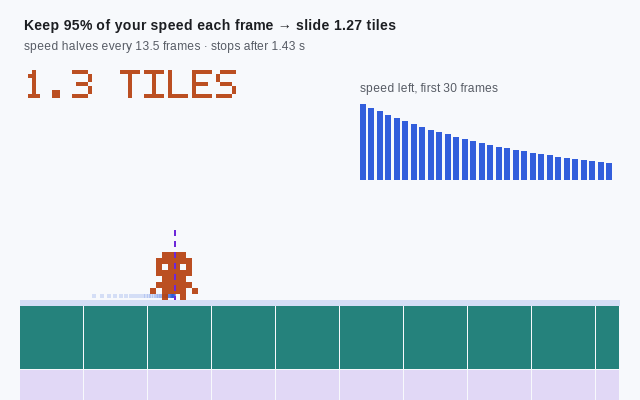
Games shrink your speed by a fraction every frame. Keep 90% and you stop fast; keep 98% and you slide five times as far.
 Go further
Turning your spaceship: where “forward” comes from
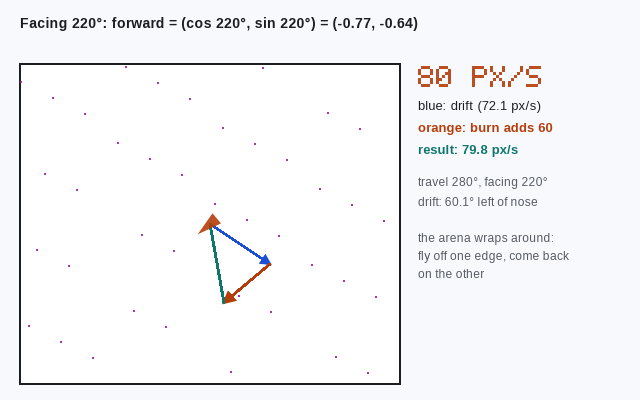
Point the ship at an angle and forward is (cos θ, sin θ). Thrust adds to the speed you already have, so in space you drift.
 Also try
Throwing a ball: the quadratic arc
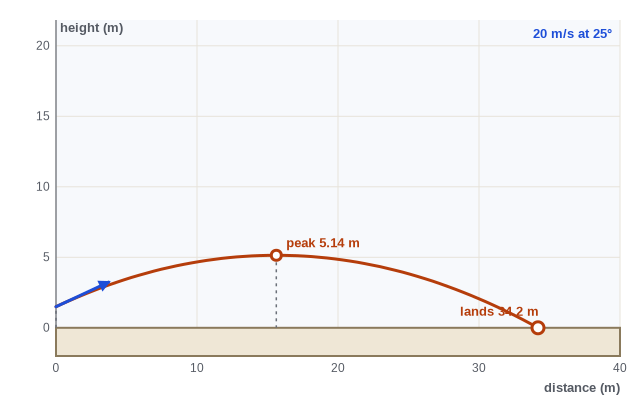
Every throw, jump, and fountain draws a parabola.
 Also try
Tuning a platformer jump: why some jumps feel floaty
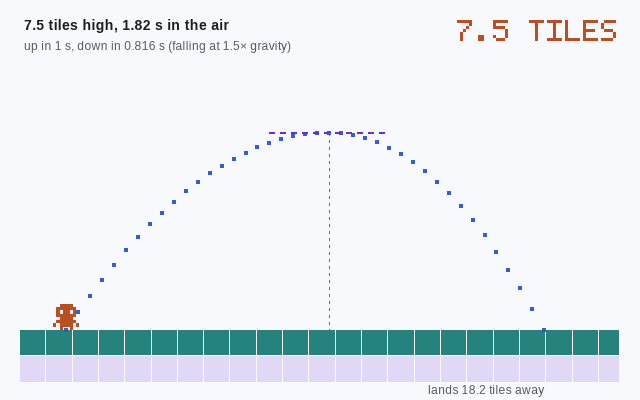
Jump height is speed² ÷ 2 × gravity. Game designers tune those two numbers, and often make you fall faster than you rise, so the jump feels just right.
Questions people ask
Why does a ball stop bouncing?
Each bounce loses some energy to heat, sound, and squishing, so it keeps only a share of its speed. The heights shrink until they're too small to see.
Does a ball bounce forever?
In the ideal math, it bounces infinitely many times, but the times add up to a finite total, so it still settles. Real balls also stop once the bounces get tiny.
What is the coefficient of restitution?
The speed right after a bounce divided by the speed right before. It's the bounciness number games and physicists use.
Updated : First published.