If an item has a 1% drop rate, how many tries will it take?
Each try is a fresh roll, so the chances don't add up to 100%. After 100 tries at 1%, about 63% of players have it and more than a third still don't. Being 90% sure takes 230 tries, and 99% takes 459. A pity timer guarantees the drop and caps the bad luck.
- Chance of at least one drop
- 40.1%
- Runs to be 90% sure
- 45
- Average runs to the first drop
- 20
This assumes every run is an independent roll at the stated rate. Some games quietly adjust rates or add hidden bad-luck protection, so real results can differ.
Challenge: Set the runs to exactly the "expected" number (100 ÷ the drop percent) and see the chance stay under 65%.
More settings
Play
Start at 1% and 100 runs, then slide the runs until the bar reaches 90%.
Challenge: Set the runs to exactly the "expected" number (100 ÷ the drop percent) and see the chance stay under 65%. The box under the picture turns green when you get it.
Stuck? Pick one of the examples from the “Try an example” menu, or press “New example.”
Understand
Each run either drops the item (chance ) or doesn't (), and runs don't remember each other. Missing times in a row has chance , so
The curve rises fast at first, then flattens: each extra run only helps the players who are still empty-handed. To find the runs for a given chance, solve with a logarithm. The dashed lines mark 50%, 90%, and 99%, and the orange bars are the runs you're willing to do.
Use
Every input has a unit menu, so you can type values in the units you already have. Results follow your units.
Show the work
- Each run misses with this chance, every time
1 - p = 0.95 - Missing every run multiplies those together, so the chance of at least one drop is
1 - (1 - 0.05)^{10} = 0.4013 - Runs for 90%: solve with a logarithm
n = \frac{\ln(1 - 0.9)}{\ln(0.95)} \to 45
Export
Set the drop chance and the runs you'll do. "More settings" adds a pity timer, a guarantee at a fixed run.
- This assumes every run is a fresh roll at the stated rate.
For learning and estimation. Verify with applicable codes, standards, and a qualified professional before using in design, construction, or safety-critical work.
Cheat card
| Symbol | Meaning | Unit |
|---|---|---|
| drop chance per run | ||
| runs | ||
| how sure you want to be |
- After 1/p runs, about 37% of players still have nothing. That's 1/e, and it holds for any small drop rate.
- Doubling your runs doesn't double your chance. Each extra run only helps the players still unlucky.
- Past runs don't count toward the next drop unless the game has a pity timer.
Where it’s used
- Computer Science
Game designers add pity timers because pure random drops leave some players unlucky for hundreds of runs. - Computer Science
The same formula estimates how many attempts a network retry or a quality test needs. - Hobbies & Crafts
Players farming a rare mount or a shiny use this to decide whether a grind is worth it.
Related exhibits
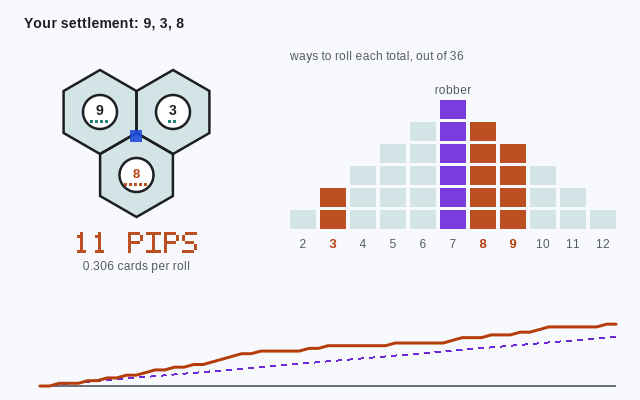 Start here
Catan dice: which settlement spots really pay?
Two dice make 7 most often and 2 or 12 least. Count the pips on a spot and you know how many cards it will hand you.
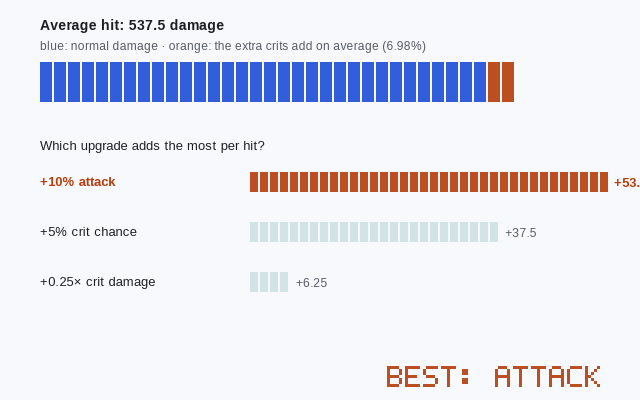 Go further
Crit chance vs. crit damage: which upgrade hits harder?
Your average hit is damage × (1 + chance × (multiplier − 1)). Compare upgrades on that one number and the best pick is obvious.
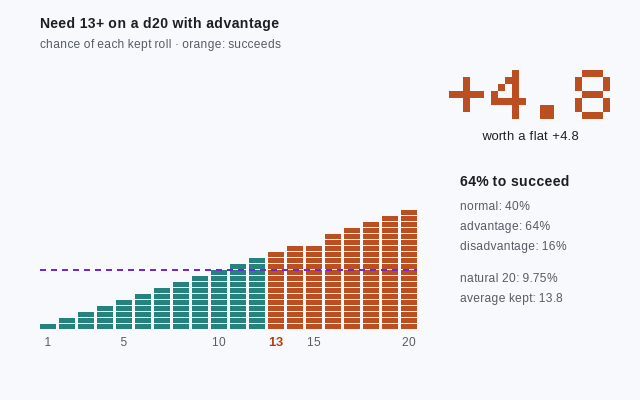 Also try
Advantage on a d20: how much is rolling twice worth?
Roll two d20s and keep the higher. It’s worth about +5 when you need an 11, but only +1 when you need a 20.
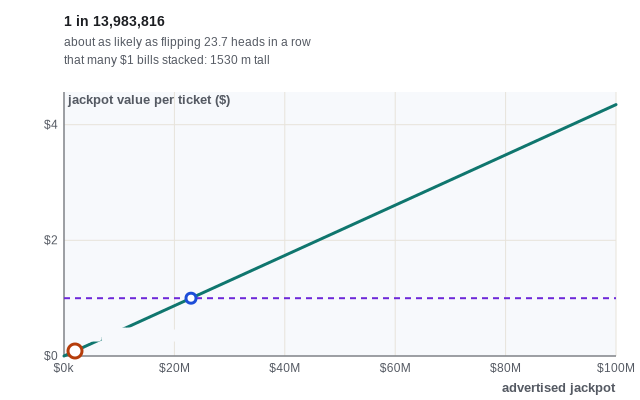 Also try
Lottery odds: what is a ticket really worth?
Powerball is 1 in 292 million. Multiply the chance by the prize, after the lump sum, taxes, and splitting, and see what $2 buys.
Questions people ask
Does a 1% drop rate mean I'll get it in 100 tries?
No. About 63% of players will, and about 37% won't. The average is 100 tries, but the unlucky tail stretches out to several hundred.
Do my failed tries make the next one more likely?
Not unless the game adds a pity system. Each try is independent, so the chance is the same every time. Thinking you're "due" is the gambler's fallacy.
What is a pity timer?
A rule that guarantees the item after a set number of misses. It caps the worst case and lowers the average wait.
Updated : First published.